
The Coach OS Drill Database
Over 1,244 drills, each individually designed and animated. Structured according to the phases of play, filterable down to single subcategories – and straight from the drill to a complete session.
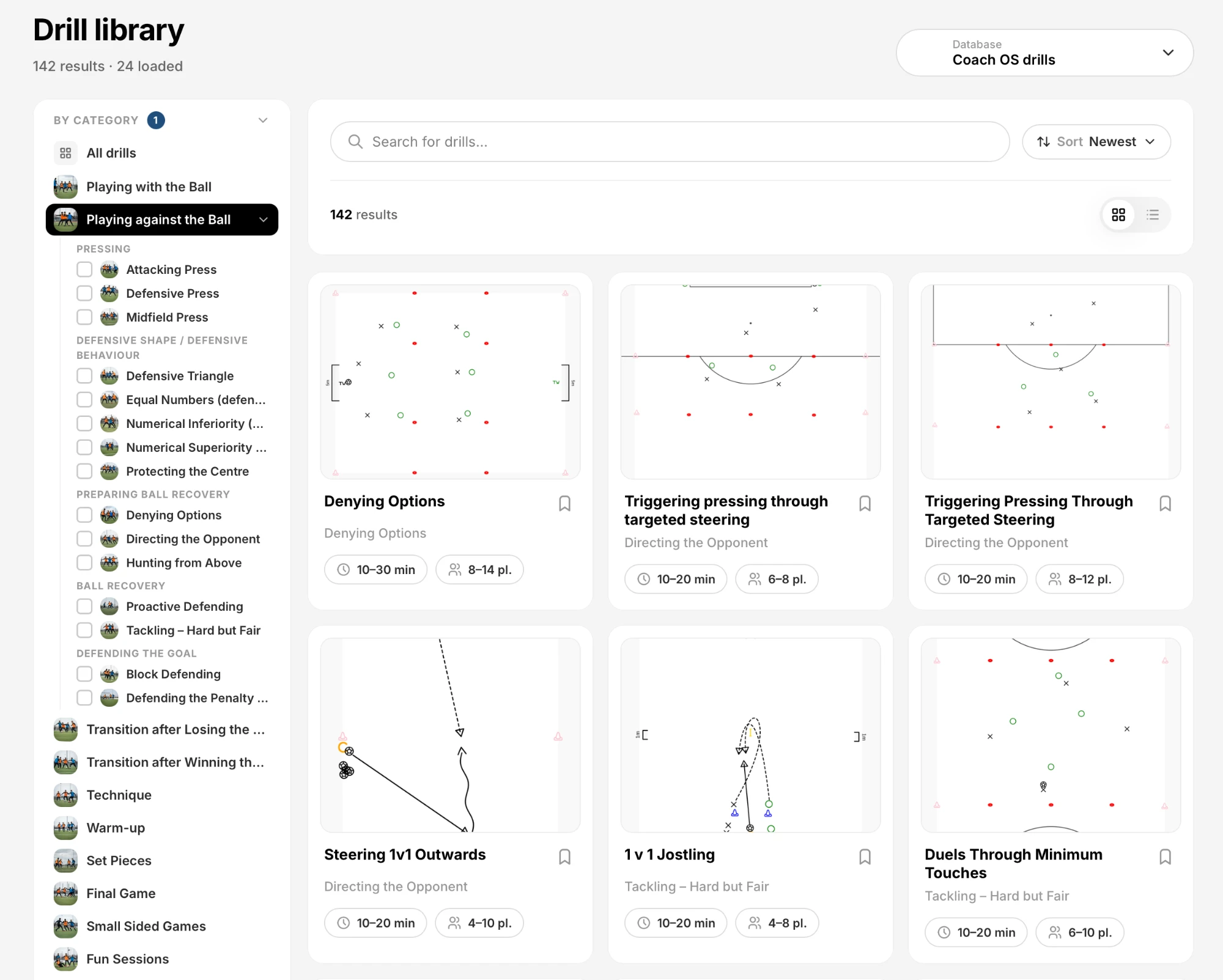
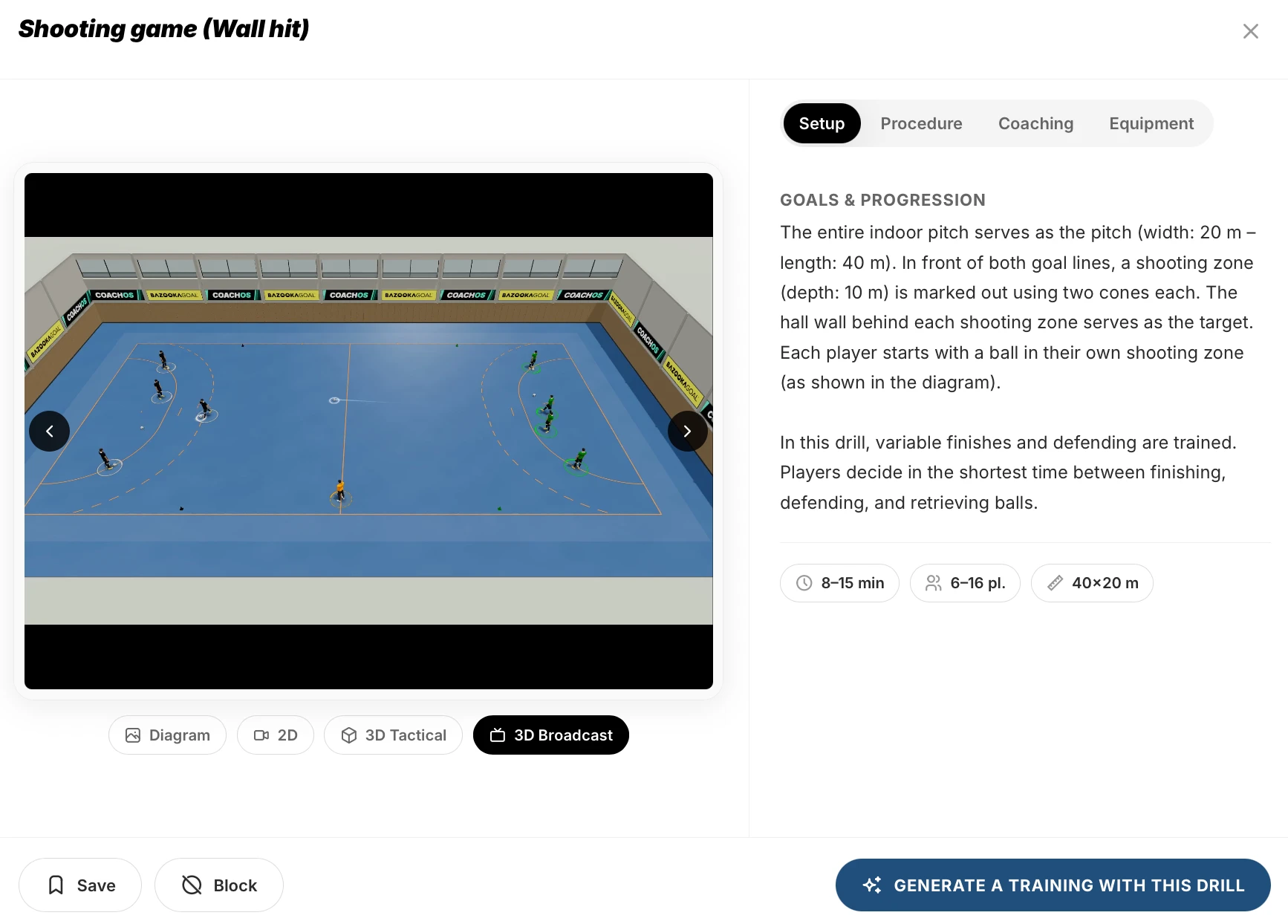
Four views of the same drill
Understanding a training drill on paper takes time. That is why every drill is available in multiple representations that you can switch between with a single click.
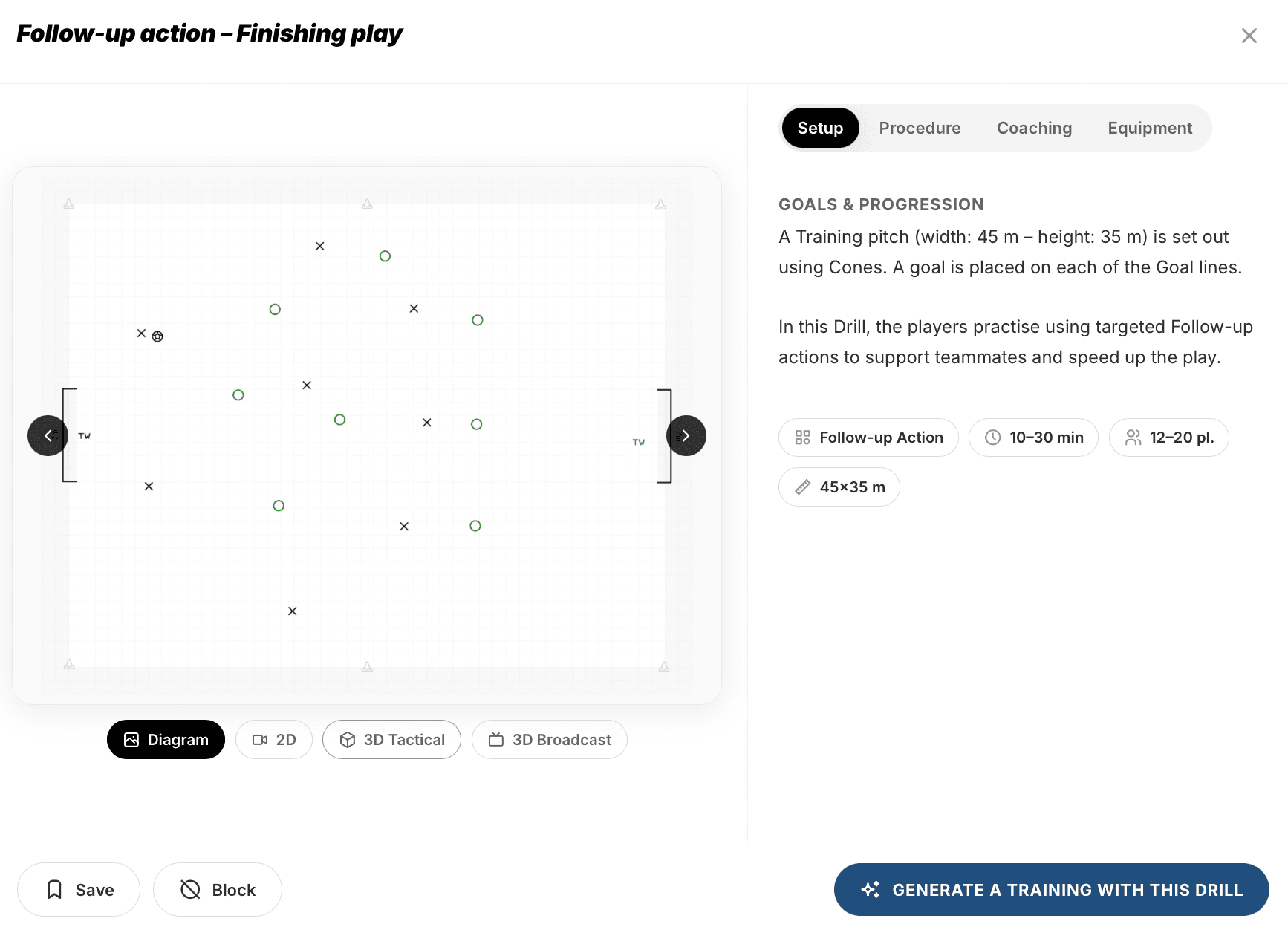
Diagram
Setup, positions and running lines as a still image. This is the view that ends up in the PDF and gets printed out for the pitch.
2D
The sequence as a top-down animation: who runs where and when, when the pass comes, where the shot is taken.
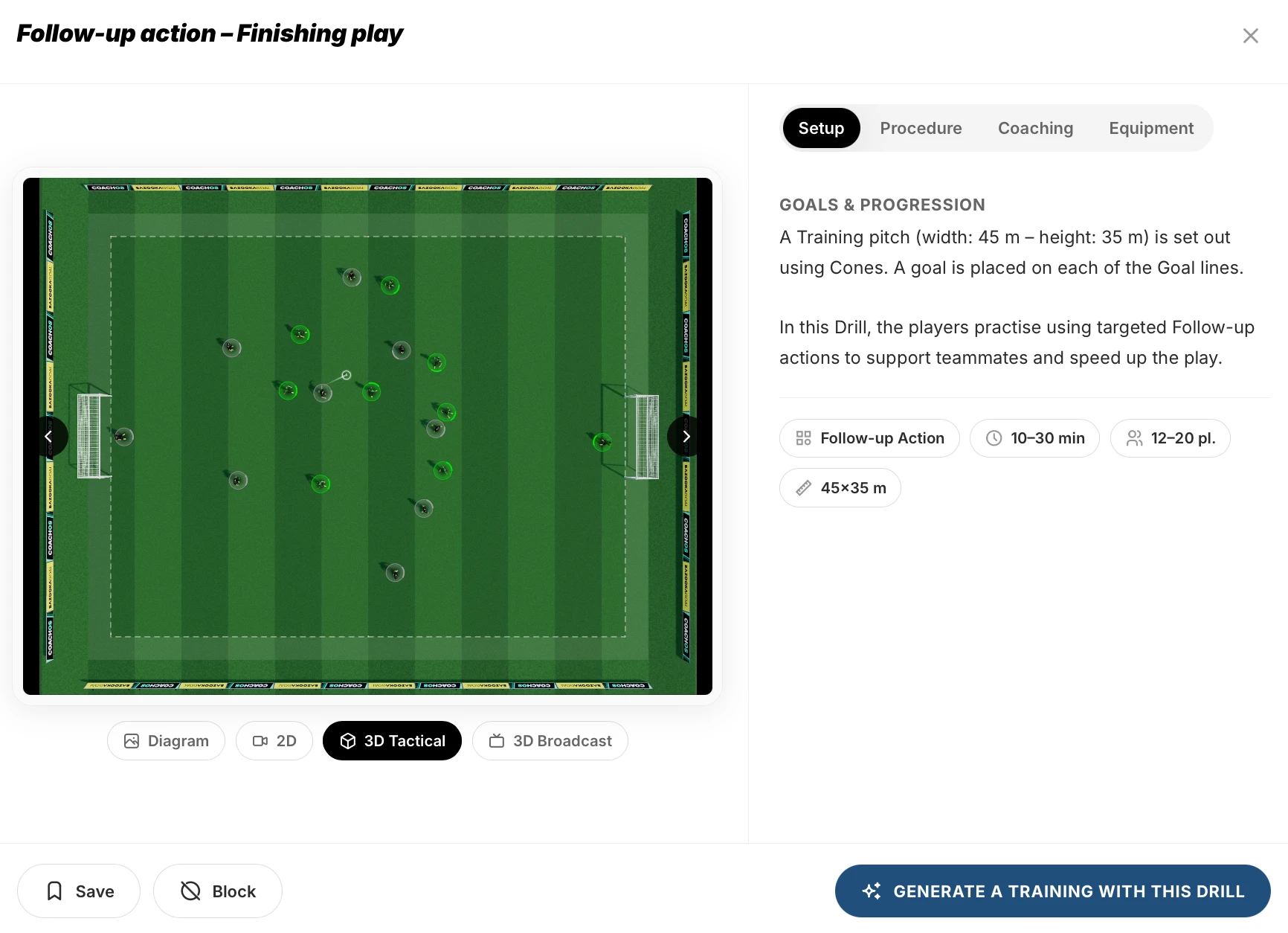
3D Tactical
The same drill in 3D, from an angled top view. Spacing and staggered positioning become visible where line diagrams remain flat.
3D Broadcast
The drill from the camera perspective of a TV broadcast – exactly as the coach sees the game on matchday.
What is inside a drill
Every drill has four tabs. None of it is continuous text you have to read through first to know if the drill fits today.
- Setup
- Pitch dimensions in meters, markers, starting positions and the goal of the drill.
- Procedure
- What happens step by step, along with variations to increase or decrease pressure.
- Coaching
- Key coaching points to watch out for and the cues that make an impact in this drill.
- Equipment
- What is required – and what can be used as a replacement if it is missing at your club.
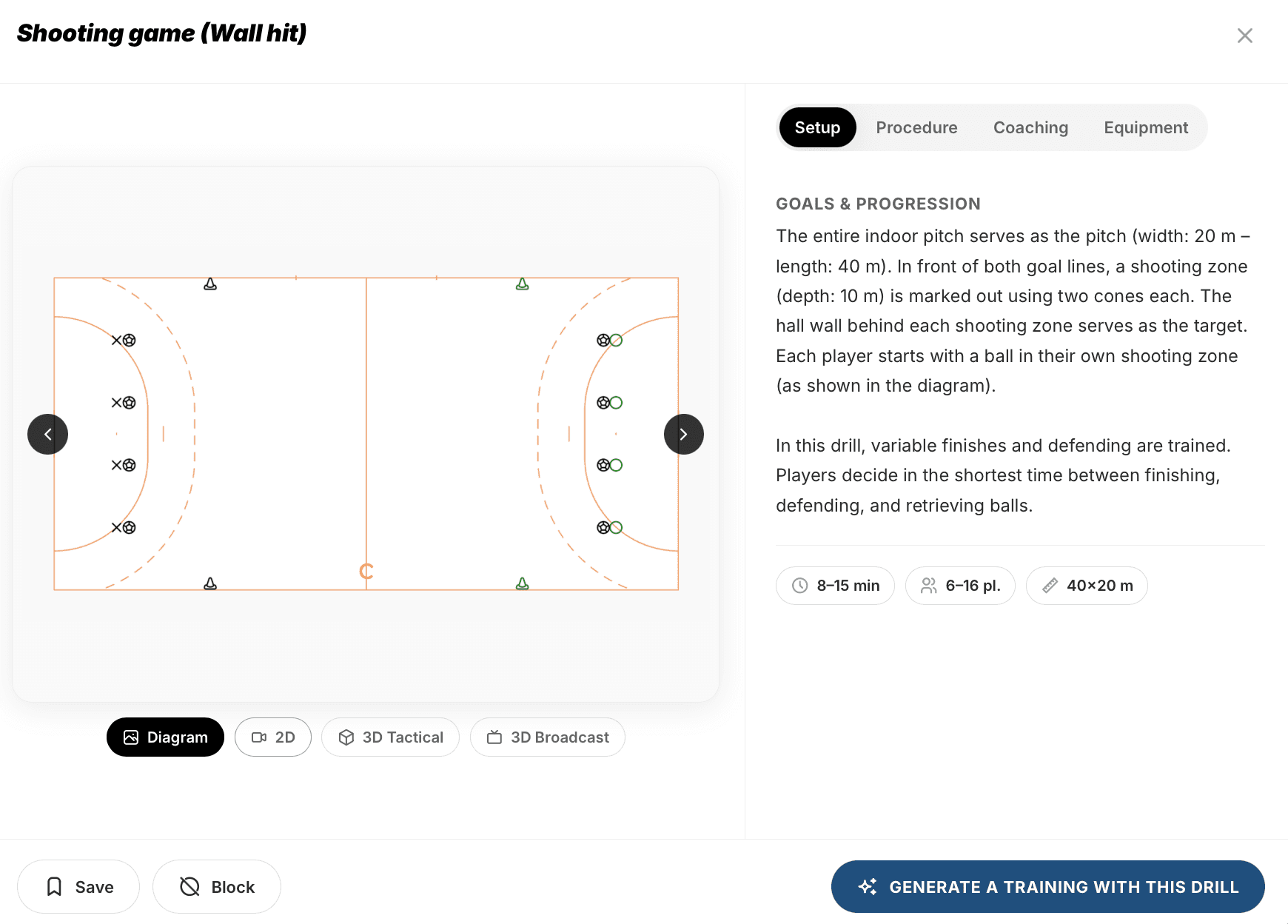
Structured according to the phases of play
Not by topics like “Passing” or “Fitness”, but by what is happening in the game right now. If you know what you want to work on, you can reach the right drill in two clicks.
- Playing with the Ball
- Build-up, Play in Depth, Wing Play, Switching Play, Play Through the Centre, Building Layers, Finding Space Behind, Creating Scoring Chances, Box Occupation, Killer Instinct
- Playing against the Ball
- Pressing (Attacking Press, Midfield Press, Defensive Press) · Defensive Shape (Defensive Triangle, Numerical Superiority, Equal Numbers, Numerical Inferiority, Protecting the Centre) · Preparing Ball Recovery (Denying Options, Directing the Opponent, Hunting from Above) · Ball Recovery (Proactive Defending, Tackling – Hard but Fair) · Defending the Goal (Block Defending, Defending the Penalty Area)
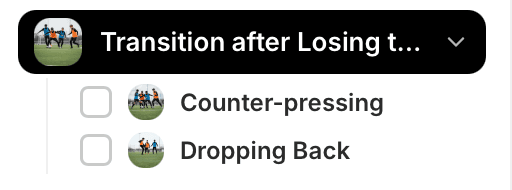
- Transition after Losing the Ball
- Counter-pressing, Dropping Back
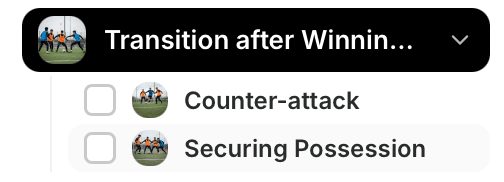
- Transition after Winning the Ball
- Counter-attack, Securing Possession
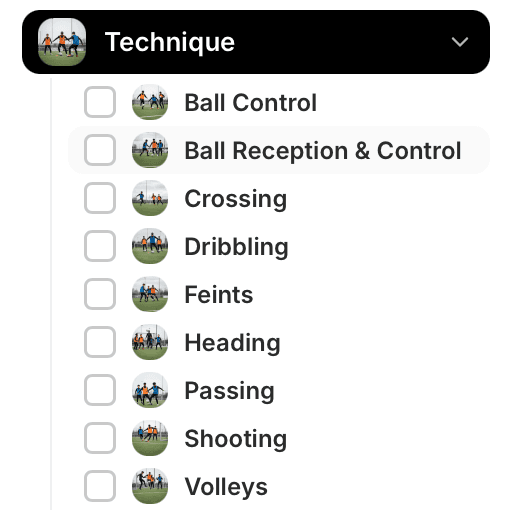
- Technique
- Ball Control, Ball Reception & Control, Passing, Dribbling, Feints, Shooting, Crossing, Heading, Volleys
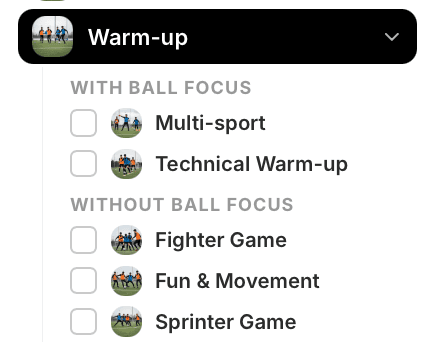
- Warm-up
- With ball focus: Technical Warm-up, Multi-sport · Without ball focus: Fighter Game, Sprinter Game, Fun & Movement
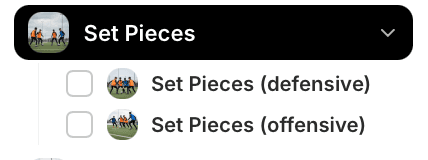
- Set Pieces
- Set Pieces (offensive), Set Pieces (defensive)
- Final Game
- The form a session ends with
- Small Sided Games
- Game forms on a small pitch, from a handful of players to the whole squad
- Fun Sessions
- For the last session before the holidays and for sessions meant to loosen up
How to find the right drill
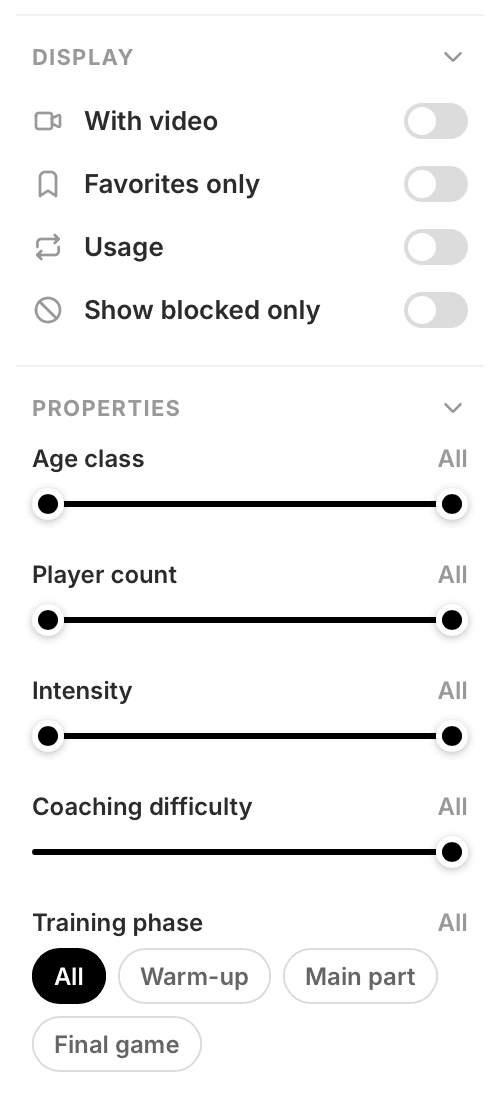
Search using free text, filter via the category tree and via properties. All filters can be combined, and the number of results is displayed above the list.
- Category
- Multiple selection across the entire tree, from the phase of play down to individual subcategories.
- Properties
- Age group, number of players, intensity and coaching difficulty, each as a range rather than a fixed value.
- Training phase
- Warm-up, main part or final game – in case you need to fill a gap in your session.
- Display
- Only drills with video, favorites only, sorted by usage, or only drills you have locked for your own team.
Every category is weighted by age and skill level
Behind every subcategory lies a weighting from U4 to Over-20s, separated into five skill levels from very weak to very strong for each age group. This is what distinguishes a drill collection from periodization.
An example: For “Overload (attacking)”, the weighting for a U8 is 10 for a very weak team and drops to 6 for a very strong team – overloads help the most where players still struggle. For a U14, this flips: it stands at 10 for both very weak and very strong teams and is lowest in the middle. Same drill, different role in the training year.
Periodization uses this to determine which drill comes next. The coach can intervene at any time, reinforce focus areas, and swap individual drills.
From drill to complete session
A complete session can be generated straight from any drill – warm-up, main part and final game are built around it. Conversely, the training generator draws from the same catalog when you start season planning. Custom drills created in Sketch appear in the same filters as catalog drills. Once ready, export as a PDF to the coaching group or view it directly on your smartphone on the pitch.
Access
The drills are reserved for members and accessible within the product, not publicly on the web. Access costs 19.90 euros per month and team, with no minimum contract term and cancellable monthly. Before that, you get 30 days free, no credit card required, with up to 30 players and up to 5 coaches or assistants per team. For clubs, the catalog is included for all coaches in the Club OS plans.
Try 30 days for freeWhat coaches ask before deciding
Seeing instead of reading: How quickly do you understand an exercise?
Every exercise is available in four views: Diagram, 2D animation, 3D Tactical, and 3D Broadcast. The diagram is what lies printed out on the pitch; the animation shows the sequence; the two 3D views make distances and staggered positioning visible that a line diagram leaves flat. All exercises are individually designed and animated – no stock material, no photographed book pages. We deliberately animate every drill because a coach on a Wednesday evening doesn't have ten minutes to reconstruct who runs where from a sketch.
Draw and animate exercises yourselfDepth of description: What is included besides the picture?
Four tabs per exercise: setup with pitch dimensions in meters and starting positions, sequence with variations, coaching with points to pay attention to, and equipment with specified alternatives. The catalog was developed with sports scientists, certified coaches, and top European academies, and it grows based on real feedback from coaches and players. We deliberately write coaching points as direct cues rather than theory because they are needed on the pitch, not in a classroom course.
The research behind periodizationSearching and filtering: How do you find the right exercise?
Free text search, plus the category tree from phase of play down to individual subcategories with multiple selection. Attributes such as age group, number of players, intensity, and coaching difficulty can be set as a range, and the session phase to warm-up, main part, or final game. Plus display filters: video only, favorites only, by usage. In the training generator, searching is completely eliminated – it selects based on your setup. We rely on pre-selection rather than a long results list because searching itself doesn't plan a session.
Find and filter suitable exercisesStructure over the season: How are the exercises connected?
The catalog is structured according to the phases of play, not by topics: in possession, out of possession, transition after ball loss and after ball recovery, technique, warm-up, set pieces, final game. Beneath these are subcategories down to "channeling the opponent" or "box occupation". Each of these is weighted by age and skill level, and periodization distributes them across the season. We deliberately organize by phases of play because after Sunday's match, a coach knows what went wrong – not which technique category they would need for it.
Periodization and long-term planningFrom finding to planning: What happens to a found exercise?
A complete session can be generated from any exercise; warm-up, main part, and final game are built around it. Conversely, the training generator pulls from the same catalog when you start with season planning. Your own exercises from Sketch appear under the same filters. The finished session is sent as a PDF to the coaching group or runs on the smartphone on the pitch, where groups can be adjusted in real time. We deliberately connect the catalog and planning because a collection without a plan merely shifts the work.
Training planning and session organizationScope: How large is the catalog?
Over 1,244 exercises, each individually designed and animated, a large portion additionally available as 3D video. All phases of play, all age groups from toddlers to senior men and women, and all skill levels are covered, plus indoor training and drills with minimal equipment. The catalog is constantly growing. We deliberately count only unique exercises and do not include variations, because a number that includes variations says nothing about how much is genuinely different.
Exercise database in footballComplete sessions: Do you get full training sessions or only individual exercises?
Both. The training generator builds a complete session in eight steps, including warm-up, main part, and final game, tailored to available space, time, number of players, coaches, and equipment. Five training models are available to choose from, including station training and group training via drag & drop. If you prefer building yourself, you can assemble the session from individual exercises. We deliberately output the finished session as a suggestion rather than a requirement – the coach decides what goes onto the pitch.
Training planning and periodizationAdapting: What if the exercise doesn't fit the evening?
Each exercise has several variations that increase or reduce pressure, and can be adapted to age, skill level, and group size. If equipment is missing, the equipment tab displays the saved alternative – a hurdle becomes a pole and cones, a full-size goal becomes two cones. Drills that aren't suitable for your team can be blocked and will no longer appear. We deliberately store alternatives directly within the exercise, because otherwise it's only noticed on the pitch when the cone bag is half empty.
Manage exercise database and training drillsAge and ability level: Does the catalog fit my age group?
Every subcategory carries a weighting from U4 to Over 20, separated for each age group across five skill levels from very weak to very strong. For example: "Overload (offensive)" is set at 10 for a very weak U8 team and drops to 6 for a very strong team; for a U14 team, it is at 10 for very weak and very strong teams and lowest in the middle. The same exercise, a different role in the training year. We store this by category because "suitable from U12" says nothing about when a drill actually makes sense.
Age-appropriate football trainingCost and entry: How much does access cost?
19.90 euros per month and team, with no minimum contract period and cancelable monthly. Prior to that, there are 30 days free, no credit card required, with up to 30 players and up to 5 coaches or staff per team. For clubs, the catalog is included in the Club OS plans and then applies to all coaches, billed centrally. The exercises themselves are reserved for members and are not publicly viewable. We state this openly instead of promising a preview that doesn't exist.
Pricing and trial phase